

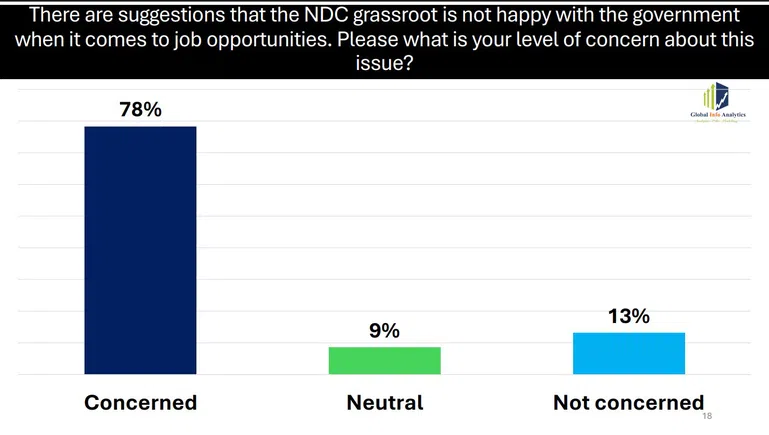
Nearly eight out of every ten grassroots members of the National Democratic Congress say the absence of jobs keeps them up at night — a stark signal that economic anxiety is now the dominant force shaping the ruling party’s internal politics.
The findings come from a sweeping Global InfoAnalytics survey that polled close to 10,400 delegates across all sixteen regions between 31 March and 9 April 2026. The research offers the clearest picture yet of what ordinary party faithful are thinking as the NDC begins charting its course beyond the John Dramani Mahama presidency toward the 2028 general elections. For a party that rode into power partly on promises of economic transformation, the depth of concern among its own supporters should ring alarm bells at national headquarters.
Seventy-eight percent of those surveyed said they worry about the scarcity of employment opportunities in the country. Only thirteen percent reported feeling unconcerned, while nine percent sat on the fence. Yet despite the anxiety, optimism has not evaporated — eighty-eight percent of respondents still believe things will get better in the near term, compared to just three percent who have lost hope and nine percent who remain unsure. That gap between present frustration and future expectation suggests delegates are giving their party’s leadership a window to deliver, but patience may not last indefinitely.
The poll also pulled back the curtain on an increasingly competitive race for the soul of the party. National Chairman Johnson Asiedu Nketia holds the early advantage at twenty-nine percent support, but Finance Minister Cassiel Ato Forson is closing ground fast at nineteen percent. The gap between the two has shrunk from sixteen points in a previous baseline survey to ten — fuelled largely by undecided delegates drifting toward the Finance Minister. Haruna Iddrisu sits third at eleven percent, with Julius Debrah and Vice President Jane Naana Opoku-Agyemang tied at eight percent each. A sizeable twenty-four percent of delegates have yet to make up their minds, making them the kingmakers in this contest.
Head-to-head matchups reinforce Asiedu Nketia’s frontrunner status, though the margins tell different stories depending on his opponent. He commands a comfortable twenty-point lead over Iddrisu and a twenty-five-point edge over Debrah. Against Ato Forson, however, the contest tightens dramatically — thirty-seven percent to thirty-two percent — with thirty-one percent still undecided, leaving everything to play for.
When asked what qualities matter most in their next leader, delegates put performance above all else at seventy-four percent. Visionary leadership followed at fifty-three percent, while being a faithful servant of government registered thirty-five percent. Loyalty to the party and personal character each scored twenty percent. Youthfulness and gender barely registered, at eight percent and one percent respectively.
The message from the NDC’s base is difficult to misread: whoever wants to lead this party into the next election cycle must first prove they can put Ghanaians to work — or risk watching that fragile optimism curdle into the kind of disillusionment that changes election outcomes.
Source: Pulse Ghana

